
Logboats
From prehistory through to the end of the Industrial revolution the waterways of Northern Ireland were not only a vital source of fish and wildfowl, but also a communication and transport highway where small boats were used to facilitate trade in goods and raw materials, move livestock and carry people between settlements.
The earliest boats on Ireland’s waterways
The earliest and simplest of these early boats was the dugout canoe or logboat. It was constructed by splitting a large tree trunk, removing its outer sapwood and bark and then hollowing it out and shaping it using axes and adze’s. In Northern Ireland most were constructed from oak, alder or poplar, as they were readily available, grew to a suitably large size and split along their grains easily. Poles and paddles were initially used for moving the boats, with oars and then sails a later development.
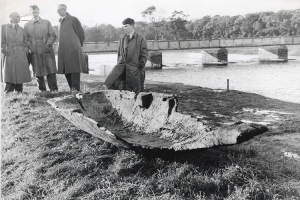
Logboats have been recovered from every major river and lake in Northern Ireland. A few have even been found in Strangford Lough which shows that they were also used in sheltered coastal seas. Our oldest logboat was recovered from Brookend on the shores of Lough Neagh. It was radiocarbon dated to 5490-5246 BC, in the middle of the Mesolithic hunter gatherer period. The latest was recovered from the River Blackwater and was dated to AD 1641-1666, a time when most boats were plank built. These later logboats are much smaller than earlier examples, most being the same size as a modern single person canoe. They were used alongside coracles (small, rounded, lightweight boats made of willow and covered with animal hide) for fishing and short river journeys.
The locations of logboats identified in Northern Ireland is available via the HED Map Viewer. The accuracy of the location of each logboat has been determined by the quality of the source. Those where the Historic Environment Division have verified the location on the ground are considered accurate (within 10m), those where the historical record provides detailed location information are considered reasonable (within 50m) and those where the historical record only details a water body or townland are considered approximate (within the waterbody or townland).
If you think you have found a logboat please report it to HERoNI and one of our archaeological team will come out to investigate.